Manama, Kingdom of Bahrain – 29 October 2026 – The Central Bank of Bahrain’s (CBB) Board of Directors held its third meeting for the year 2026, chaired by Mr. Hassan Khalifa Al Jalahma.
The Board reviewed the items on the agenda, and H.E. Mr. Khalid Humaidan presented the latest developments regarding the CBB’s key priorities. The Board also reviewed the CBB’s performance report and other key achievements during the period under review this year. The meeting also discussed the second edition of the Graduate Development Programme (GP15), following the success of its first edition, which attracted three times as many applications. In addition, the Board discussed the latest developments regarding the CBB’s Artificial Intelligence Strategy.
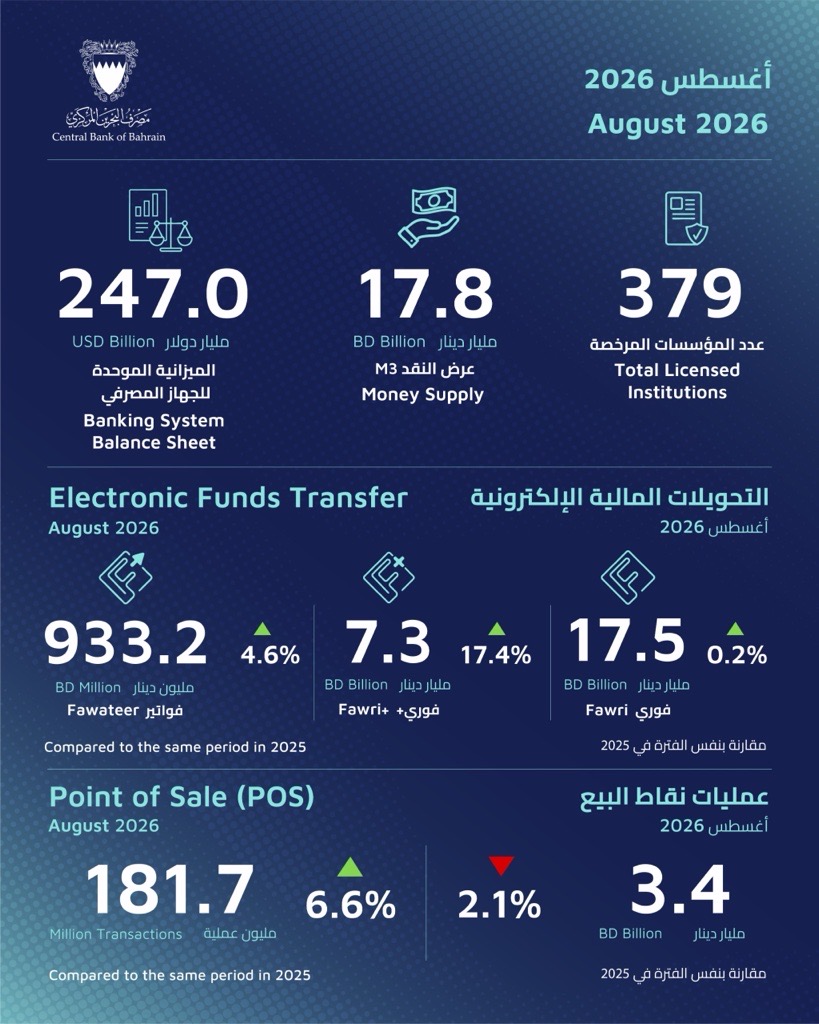
The Board also reviewed key monetary and banking indicators for the period up to August 2026 including the money supply, which increased by BD 1.4 billion to reach BD 17.8 billion at the end of August 2026, compared to the same period in 2025. As for retail banks, total private deposits increased to reach BD 14.6 billion at the end of August 2026, an increase of 8.0% compared to the end of August 2025. The outstanding balance of total loans and credit facilities extended to resident economic sectors increased to BD 13.6 billion at the end of August 2026, an increase of 7.8% compared to August 2025, with the Business Sector accounting for 39.4% and the Personal Sector at 47.6% of total loans and credit facilities. The balance sheet of the banking system (retail banks and wholesale sector banks) increased to $247.0 billion at the end of August 2026, an increase of 0.1% compared to the end of August of 2025.
Point of Sales (POS) data for the period January 2026 to August 2026 totaled 181.7 million transactions (77.2% of which were contactless), an increase of 6.6% compared to the same period in 2025. The total value of POS transactions for the period January 2026 to August 2026 totaled BD 3.4 billion (53.4% of which were contactless), a decrease of 2.1% compared to the same period in 2025.
The banking sector’s capital adequacy ratio reached 21.3% in Q2 2026 compared with 20.2% in Q2 2025. The capital adequacy ratio for the various banking sectors was 27.2% for conventional retail banks, 18.0% for conventional wholesale banks, 25.5% for Islamic retail banks, and 16.2% for Islamic wholesale banks in Q2 2026.
The total number of registered Collective Investment Undertakings (CIUs) as of June 2026 stood at 1683 CIUs. The net asset value (NAV) of the CIUs increased from US $10.915 billion in Q2 2025 to US $11.505 billion in Q2 2026, reflecting an increase of 5.41%. Moreover, the NAV of Shari’a-compliant CIUs increased from US $2.060 billion in Q2 2025 to US $2.928 billion in Q2 2026, reflecting an increase of 42.14%. With regard to Bahrain domiciled CIUs, the NAV increased from US $4.343 billion in Q2 2025 to US $4.425 billion in Q2 2026, reflecting an increase of 1.89%. Additionally, the NAV of overseas domiciled CIUs increased from US $6.572 billion in Q2 2025 to US $7.081 billion in Q2 2026, reflecting an increase of 7.75%.